Terry towels represent the gold standard in absorbent textiles, powering everything from luxury hotel baths to institutional laundry worldwide. This guide explores their fabric construction, optimal GSM weights, and essential certifications, key knowledge for importers and wholesalers evaluating suppliers. Whether sourcing for hospitality or retail, understanding terry towels ensures better product performance and compliance.
We'll cover the anatomy, material options, weight benchmarks, and standards that define quality, drawing on industry benchmarks to help you spec the right products.
Anatomy of Terry Towels: How Loops Create Superior Absorbency
Terry fabric distinguishes itself through a unique pile weave: uncut loops on one or both sides trap water far more effectively than flatwoven towels. The structure includes a ground warp for stability and pile warp yarns, often zero-twist for maximum fluff that form those signature loops.
This design allows terry towels to absorb up to 7 times their weight in water, a critical factor for high-traffic environments like spas or gyms. Production begins with ring-spun yarns (smoother than open-end), woven on specialized looms, then cut, dyed, and finished. Pakistan, a global leader in home textile exporting over $1.2 billion annually in terry products, exemplifies this process at scale.
Leading Towels manufacturers like Polani Textiles in Karachi leverage advanced looms to maintain pile height consistency, minimizing defects below 1%.
Fabric Types: Cotton, Bamboo, Blends, and Performance Options
Terry towels come in varied compositions, each suited to specific uses and budgets.
- 100% Cotton Terry: The traditional choice, with long-staple Egyptian or Pima varieties offering plushness and durability. Ring-spun cotton prevails in premium lines for its smoothness.
- Bamboo Blends: Eco-friendly 60/40 cotton-bamboo mixes provide natural antibacterial properties and silkier feel, ideal for healthcare.
- Turkish/Premium Terry: Zero-twist piles boost absorbency by 20% over standard twists.
- Microfiber-Infused Quick-dry synthetics for gyms or pools.
Cotton dominates 80% of global exports due to its balance of cost and performance. For B2B buyers, blends allow customization. Polani Textiles offers these with private labeling.
GSM Explained: Choosing Weight for Luxury vs. Utility
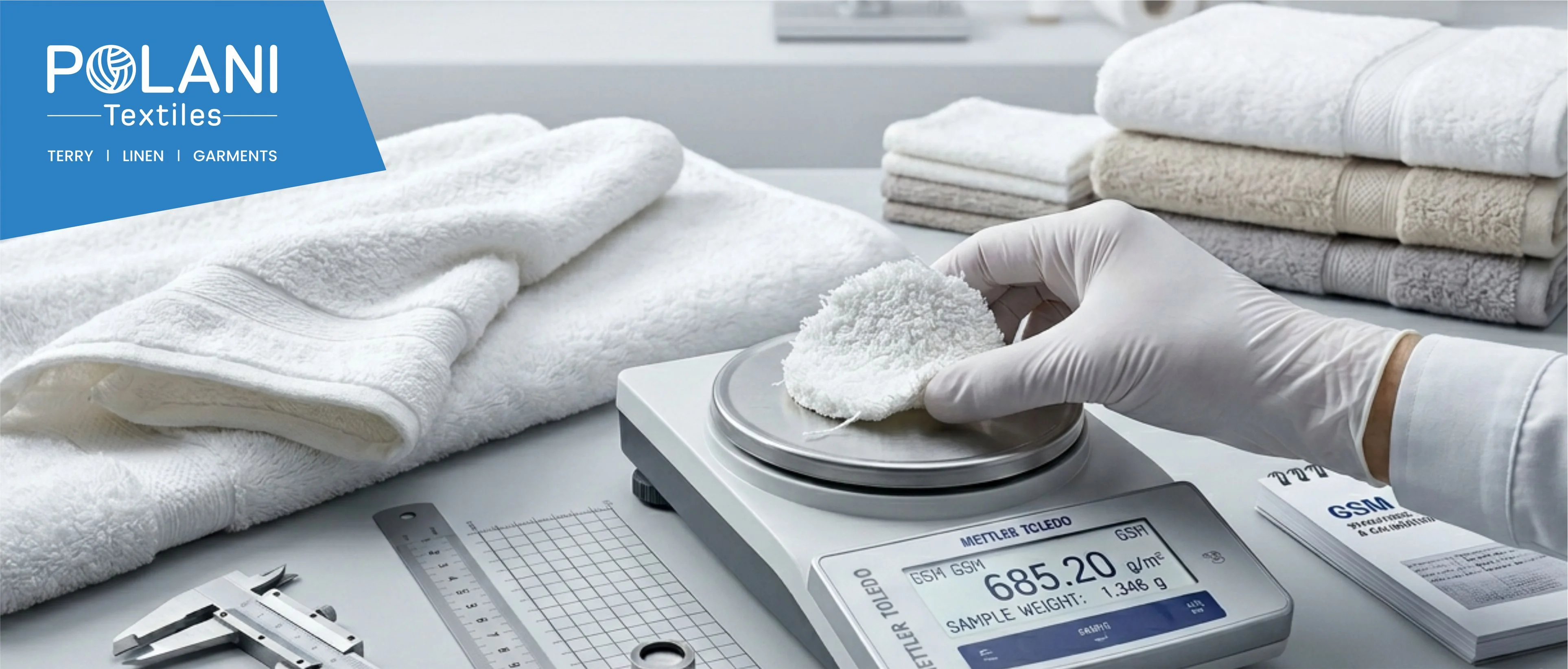
Grams per square meter (GSM) measures towel density, directly impacting hand-feel, absorbency, and drying time. Lighter towels suit daily rotation; heavier ones deliver hotel luxury.
| GSM Range | Absorbency Level | Ideal Applications | Drying Time |
|---|---|---|---|
| 300-450 | Good | Hand/face towels, institutions | Fast |
| 450-600 | Excellent | Bath towels, hospitality | Moderate |
| 600-900 | Superior | Beach sheets, 5-star resorts | Slower |
Industry sweet spot? 500-550 GSM for 70% of wholesale orders, balancing plushness without bulk. Higher GSM requires stonewashing for softness, essential for repeat hospitality use. Importers in Europe or USA often spec 550+ for premium tiers.
Global Certifications and Standards for Compliant Terry Towels
No serious B2B buyer skips certifications. OEKO-TEX Standard 100 verifies no harmful substances, mandatory for EU REACH and USA CPSIA compliance. BSCI audits ethical labor; GOTS certifies organics.
Testing covers colorfastness (no bleeding post-50 washes), AQL defect rates under 2.5%, and pile retention. Pakistan's exporters meet these via in-house labs, with 25% of Europe's hospitality towels sourced compliantly from the region.
Polani Textiles holds ISO 9001, OEKO-TEX, and BSCI, ensuring seamless customs for USA, Spain, Germany, and GCC shipments.
Manufacturing Processes: From Yarn to Finished Terry Towels
Quality terry starts upstream: yarn spinning (ring vs. open-end), weaving (dobby/jacquard patterns), jet dyeing for even color, and finishing (enzymes for ultra-soft loops). Modern factories process 10M+ meters yearly, with Pakistan's sector hitting 400M dozen units.This is the brief manufacturing process for understanding. For complete manufacturing process, visit Polani Textiles Production steps.
Key predicates for buyers: low MOQs (5K pcs), 4-6 week lead times, FOB flexibility. This scalability suits wholesalers scaling for seasonal peaks.TDAP Towel Industry Report
Polani Textiles integrates these steps in Karachi, pairing terry with bed linen bundles.
Trends and Buying Tips for Wholesale Terry Towel Importers
Sustainability rises: recycled cotton terry and low-water dyeing gain traction. Hospitality favors sets (towel + robe), while healthcare demands antibacterial finishes.
Tips: Request 450 GSM samples for testing; audit supplier certifications; factor 30-day EU shipping. For private labels, prioritize dobby borders for differentiation.
Ready to source compliant terry towels? Polani Textiles offers free GSM samples tailored to your market, USA, Europe, GCC.