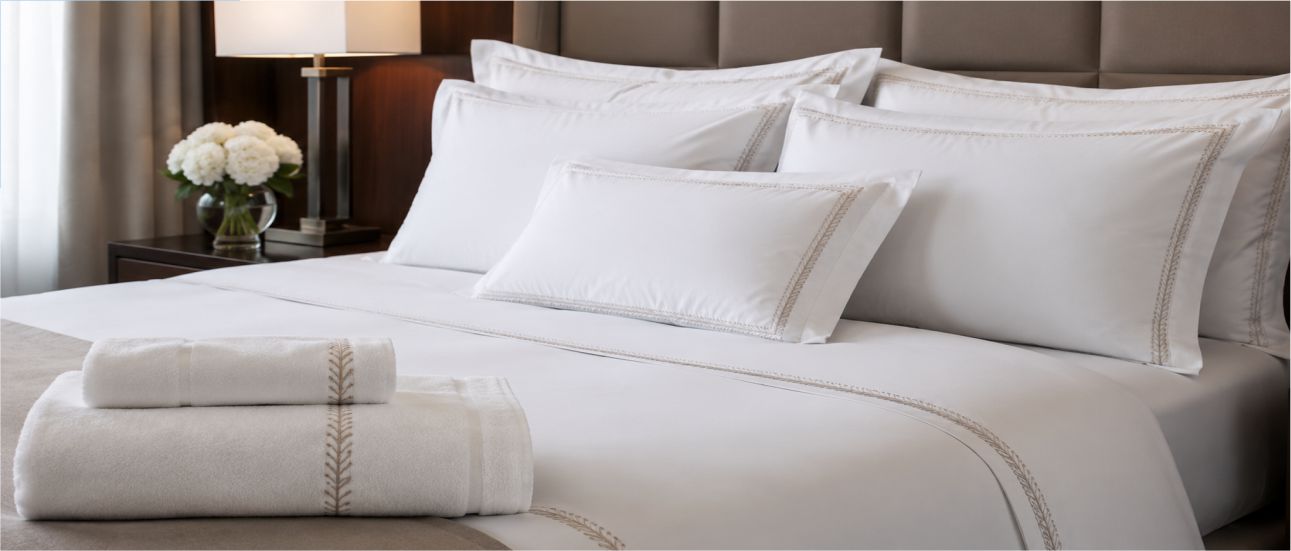
A logo on a hotel towel works as branding only while it looks intentional. Once the thread frays, the colour dulls against the terry, or the outline warps after dozens of industrial wash cycles, the towel starts signalling cost‑cutting rather than a well‑run property. The outcome depends on two things: how the logo is applied and which thread or yarn is specified. Get either wrong and the investment won’t survive the laundering it’s supposed to handle.
This guide explains:
- The difference between embroidery and woven‑in branding.
- Why trilobal polyester embroidery thread tested to ISO 15797 matters for durability.
- How branding affects towel loss and theft.
- Practical decisions on logo placement and product mix.
Embroidery vs Woven‑In Branding: What’s the Real Difference?
Embroidery stitches a logo onto finished fabric after weaving. Woven‑in branding builds the logo into the fabric during weaving, using dobby or jacquard depending on design complexity.
How Each Method Works
Embroidery
- Logo applied after the towel or robe is produced.
- Uses machine embroidery with dedicated thread.
- Suits smaller batches and multiple logo versions.
Woven‑in branding (dobby / jacquard)
- Logo created as part of the weave structure.
- Dobby handles simpler bands and geometric marks.
- Jacquard handles detailed, multi‑element logos.
- More cost‑efficient at high volume, but must be planned into loom setup.
Does Thread Choice Matter More Than Logo Design?
For embroidery, thread choice matters more than many buyers realise. Standard sewing thread is not built for institutional laundering: repeated high‑temperature washing, industrial detergents, and sometimes chlorine bleach.
Why Trilobal Polyester Embroidery Thread?
Leading industrial embroidery threads, such as trilobal polyester ranges like Isacord, are:
- 100% trilobal polyester, continuous filament.
- Engineered for industrial wash conditions, with Pro‑Care certification for ISO 15797 industrial laundry testing.
- Rated for excellent colour fastness and structural stability under boiling and bleaching.
ISO 15797:2017 defines lab procedures that simulate industrial washing and finishing for workwear and similar textiles, evaluating dimensional stability, colour characteristics, seams, and overall visual aspects. Threads tested against this standard remain visually sound through the same types of cycles hotel towels and bathrobes face in commercial laundries.
By contrast:
- Rayon and cotton embroidery threads often look identical on day one.
- Under industrial washing, they fade sooner and lose strength faster than the surrounding terry.
- Result: logos look tired while the towel base is still usable.
For buyers, specifying ISO‑tested trilobal polyester thread is one of the simplest ways to protect brand marks over the life of the linen.
Embroidery vs Woven‑In Branding at a Glance
| Aspect | Embroidery | Woven‑in (dobby / jacquard |
|---|---|---|
| How applied | Stitched onto finished fabric | Built into weave during production |
| Visual effect | Raised, dimensional; high sheen with polyester | Flat, tone‑on‑tone or subtle contrast |
| Wash durability | High with ISO 15797‑tested thread | High; logo is structural, not applied |
| Typical MOQ | Lower; addable to smaller batches | Higher; tied to planned loom runs |
| Lead‑time impact | Adds a small step to standard production | Extends base weaving lead time |
| Best fit | Boutique properties, multiple logo variants | Large chains standardising one logo at scale |
For chains standardising one mark across thousands of towels, woven‑in jacquard or dobby branding is often more efficient. For mixed portfolios and brand families, embroidery provides flexibility without changing loom setups.
Does Branding Actually Reduce Towel Theft and Loss?
Branding isn’t a cure‑all, but it does act as a deterrent. Multiple hotel‑industry sources estimate theft costs around USD 100 million per year in the US alone, with towels consistently cited as the most frequently stolen item. (yahoo)
Examples:
- Surveys show towels top hotel theft lists, with over 80% of respondents calling them the item most often taken. (AL.com)
- Associations and industry reports repeatedly quote ~USD 100 million in annual hotel theft losses, towels included.
Branding helps by:
- Making towels visibly hotel property, reducing resale appeal.
- Signalling that the linen is part of tracked inventory.
- Working alongside RFID tagging or fee policies where properties use them. linkedin
It doesn’t stop all loss, but it pushes casual “souvenir” behaviour down and shifts more value into legitimate experiences and retail programs.
Where Should the Logo Go, and Does Placement Affect Durability?
Placement is primarily a brand and aesthetic decision, but durability enters the picture too.
Why Choose Polani Textiles for Kids Wholesale Beach Towels?
Placement is primarily a brand and aesthetic decision, but durability enters the picture too.
Practical Placement Guidelines
Common placements:
- Bath towels: Corner or lower edge, away from main fold lines.
- Hand towels: One short‑edge band.
- BathRobes: Chest‑height, above the pocket line.
- Bath mats: One corner or central panel, depending on pattern.
Durability implication:
- Logos placed directly on fold lines experience more mechanical stress: constant creasing, stacking, and trolley pressure.
- Over hundreds of cycles, this increases thread wear even when the thread spec is correct.
Specifying placement and thread type together at the ordering stage avoids learning about extra wear only after a few hundred cycles.
By partnering with the top towel manufacturer from Pakistan i.e. Polani Textiles, you’ll get all the checks right and secure branded hotel linen that keeps its logo sharp and colour‑true through every industrial wash cycle.
FAQ – Embroidered & Branded Hotel Linen