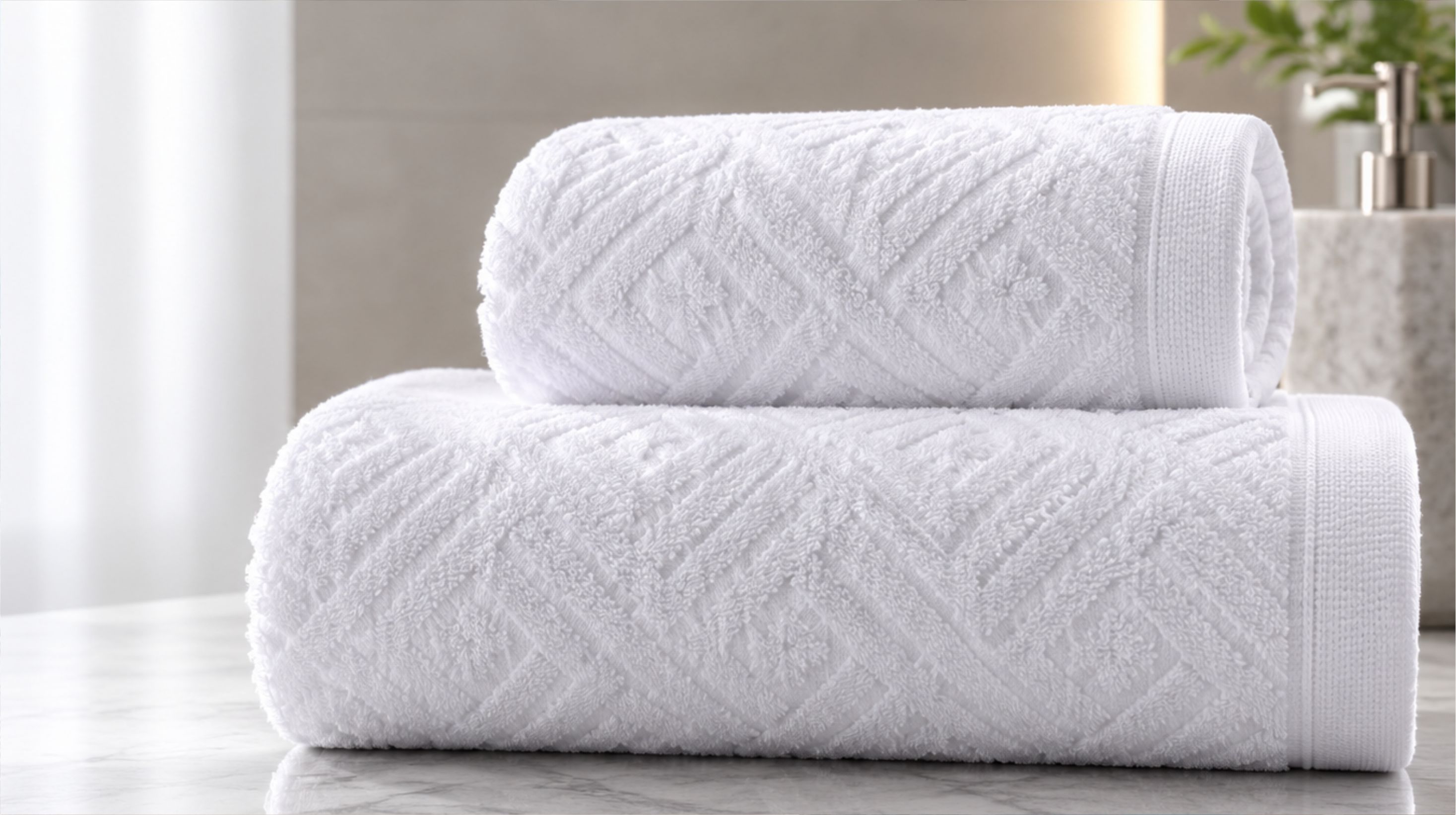
Jacquard towels give hotel bathrooms a more distinctive appearance than plain terry towels. Their patterns are created through the weaving structure rather than applied only to the surface. This allows buyers to specify woven borders, geometric motifs, textured panels, and subtle brand details for guest rooms, spas, and retail collections.
However, a decorative pattern should not be the only selection criterion. For hotel procurement teams, the right jacquard towels for hotels must also provide suitable absorbency, manageable drying time, dimensional stability, and resistance to repeated commercial laundering.
The key specifications to compare are:
- GSM and towel weight.
- Cotton and yarn construction.
- Pattern scale and placement.
- Pile height and surface texture.
- Hem and border strength.
- Colourfastness and shrinkage.
- Laundry capacity and replacement cycle.
- Sample, MOQ, and replenishment requirements.
This guide explains how to choose jacquard towels that fit your property’s service level, operating conditions, and visual identity.
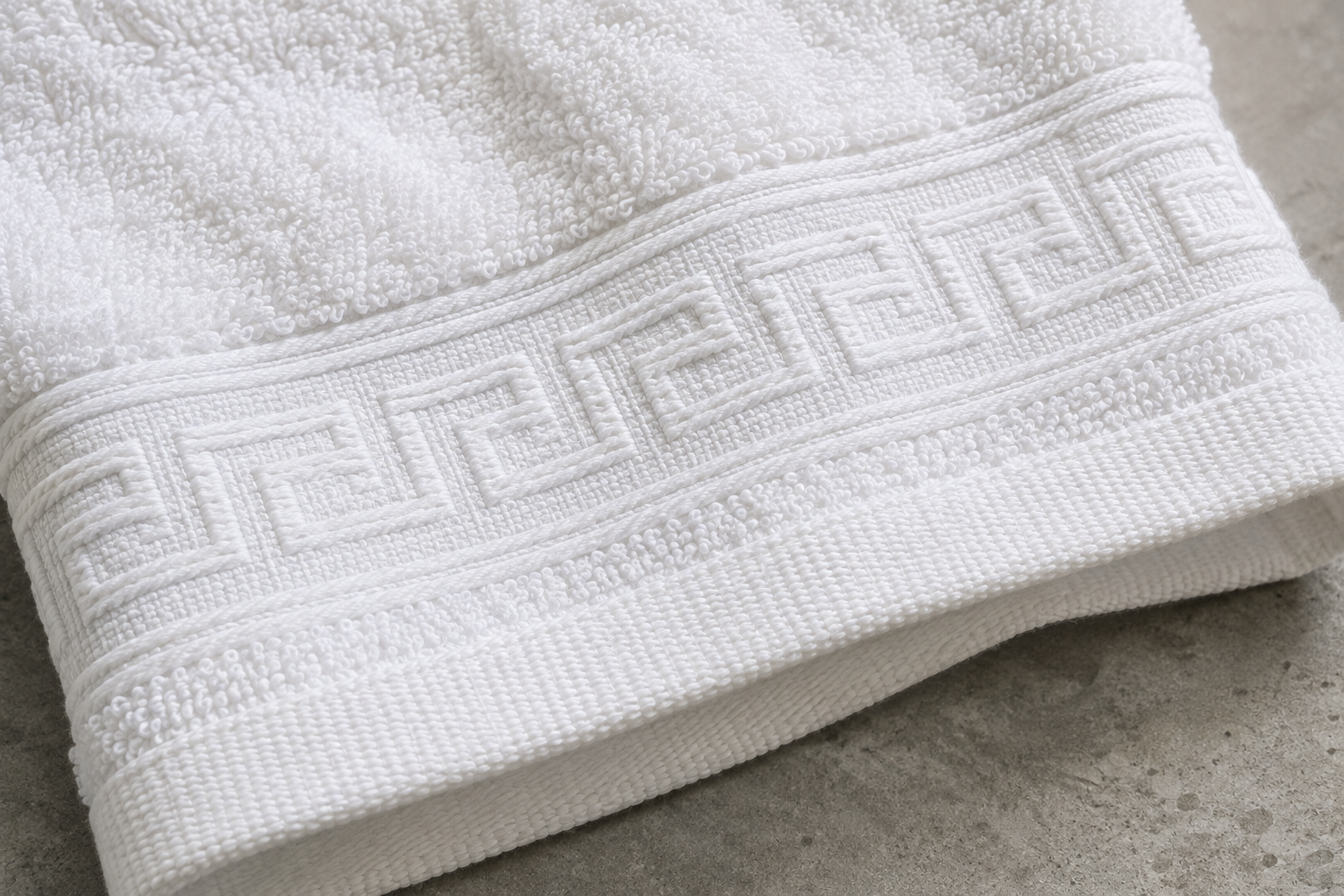
What Are Jacquard Towels for Hotels
A jacquard towel is a terry towel with a woven pattern created through controlled yarn and loom operations. Unlike a printed towel, the design is integrated into the fabric. Unlike a simple dobby border, jacquard construction can support more detailed motifs and larger pattern arrangements, depending on the loom and production setup.
Hotel jacquard towels may include:
- Woven geometric borders.
- Check and diamond motifs.
- Floral or decorative patterns.
- Tone-on-tone texture.
- Woven logo elements.
- Decorative panels near the hem.
The design can be subtle or highly visible. For hotels, tone-on-tone white jacquard is often used when the property wants a premium look without introducing strong colour contrast.
Jacquard is a construction method, not a guarantee of quality. The towel can still vary in absorbency, softness, durability, and weight depending on the cotton, yarn, pile, finishing, and stitching.
Which GSM Should Hotel Buyers Choose?
GSM means grams per square metre. It indicates the fabric’s mass and helps buyers compare towel density. A higher GSM generally means a heavier and more absorbent towel, but it also usually increases drying time, storage volume, and laundry cost.
Hotel Linen programs, especially towels, commonly fall within the 300–650 GSM range, with the exact choice depending on hotel tier, climate, laundry equipment, and guest expectations.
=| GSM range | Typical hotel use | Main advantage | Main consideration |
|---|---|---|---|
| 300–400 GSM | Economy rooms, gyms, high-turnover use | Faster drying and lower weight | Less plush hand feel |
| 400–500 GSM | Midscale and standard full-service hotels | Balanced absorbency and drying | Moderate storage and laundry demand |
| 500–600 GSM | Upscale hotels, suites, spas | Softer and more luxurious | Longer drying and higher cost |
| 600+ GSM | Luxury suites and premium spa programmes | Maximum weight and plushness | Requires strong laundry capacity |
For many hotel programs, 400–600 GSM offers a practical balance. A luxury property may select 600–700 GSM, but the laundry team should confirm that dryers, storage, and transport systems can manage the additional weight.
Do not specify GSM alone. Ask for:
- Finished size.
- Finished weight.
- GSM tolerance.
- Shrinkage allowance.
- Wash-test results.
- Absorbency performance.
How Does Pattern Design Affect Performance?
Jacquard patterns can influence the towel’s surface, pile distribution, and visual weight. A dense woven border may feel firmer than the surrounding terry pile. A raised motif may create a more textured surface but can require careful laundering to protect the pattern.
When selecting a hotel jacquard design, assess:
Pattern scale
Small geometric patterns are usually easier to standardise across hand towels, bath towels, and bath sheets. Large motifs may require different pattern adjustments for each towel size.
Pattern placement
A border placed near the hem can create a refined appearance while leaving the main towel surface open for absorbency. A large pattern across the towel body creates stronger visual impact but should be tested for hand feel and water pickup.
Contrast
Tone-on-tone jacquard is suitable for understated hotel branding. Strong colour contrast may support a resort or retail collection, but it increases the importance of colourfastness and batch matching.
Logo integration
A woven logo may work for simple, repeatable shapes. Detailed brand marks may require a different construction or embroidered application. Confirm the supplier’s actual loom capability before promising a particular level of detail.
Which Cotton and Yarn Should You Specify?
Cotton type and yarn construction affect softness, strength, absorbency, and pilling. Common options include:
- Carded cotton: Practical and cost-efficient for many commercial programmes.
- Ring-spun cotton: Produces smoother and more consistent yarn.
- Combed cotton: Removes shorter fibres and can provide a cleaner, softer surface.
- Long-staple cotton: Often selected for premium softness and strength.
- Zero-twist or low-twist yarn: Creates a softer, more open pile but may require careful laundering.
The best option depends on your hotel’s price tier and operating conditions. A premium yarn does not compensate for poor construction, weak hems, or unsuitable finishing.
When requesting a jacquard towel quotation, specify:
- Fibre composition.
- Yarn type.
- Yarn count, if required.
- Pile height.
- Ground and pile construction.
- Border structure.
- Finished GSM.
- Colour and pattern reference.
How Durable Are Jacquard Towels in Commercial Laundry?
Jacquard towels for hotels must withstand repeated washing, drying, folding, storage, and handling. Durability depends on the complete product, not only the woven pattern.
Review these performance areas:
- Dimensional stability.
- Colourfastness to washing.
- Colourfastness to chlorine, where applicable.
- Tensile strength.
- Loop stability.
- Hem strength.
- Pattern retention.
- Pilling and surface wear.
- Absorbency after repeated washing.
A towel can retain its pattern but still fail because the hem frays, the loops pull, or the fabric shrinks beyond the buyer’s tolerance. Request a documented wash protocol and ask how many cycles were completed.
Do not accept “hotel quality” as a complete technical specification. Ask for measurable results.
How Do Jacquard Towels Compare With Dobby Towels?
Jacquard and dobby towels are both woven patterned products, but they serve different design and purchasing needs.
| Feature | Jacquard towel | Dobby towel |
|---|---|---|
| Pattern complexity | More detailed motifs possible | Simpler stripes and geometric patterns |
| Typical application | Borders, large motifs, woven designs | Structured borders and repeated bands |
| Visual effect | Textured, decorative, premium | Clean, restrained, commercial |
| Design planning | Requires detailed loom development | Usually simpler setup |
| Cost | Can be higher for complex designs | Often more economical |
| Best fit | Luxury hotels, retail, private label | Standard hotel and institutional programmes |
Choose jacquard when pattern and differentiation are central to the product. Choose dobby when you want a practical decorative border with simpler production planning.
What Should Buyers Check Before a Bulk Order?
Before approving a large order, request a sample made to the proposed construction. A stock sample may not represent the final jacquard pattern, GSM, yarn, or finish.
Pre-order checklist
- Confirm fabric composition.
- Confirm finished size and tolerance.
- Verify GSM after finishing.
- Review pattern artwork and scale.
- Test absorbency.
- Conduct a wash trial.
- Check shrinkage after washing.
- Inspect hem and corner stitching.
- Review colourfastness.
- Confirm packing and carton quantities.
- Agree on inspection standards.
- Confirm MOQ, lead time, and replenishment terms.
For multi-property hotel groups, approve a master sample and retain a signed reference sample for future production comparisons.
How Can Hotels Use Jacquard Towels Across Their Property?
Jacquard towels can be specified for different areas:
- Guest rooms: Tone-on-tone borders and medium-to-heavy GSM.
- Suites: Larger bath sheets and premium patterns.
- Spas: Softer, higher-GSM options where drying capacity allows.
- Restaurants and bars: Smaller jacquard hand or bar towels.
- Restaurants and bars: Smaller jacquard hand or bar towels.
- Retail boutiques: Fashion colours, custom patterns, and private labels.
- Pool areas: Only when the dye and construction are tested for outdoor and chlorine exposure.
Keep guest-room, spa, and pool programmes separate unless the towel has been tested for all intended conditions.
Request a Jacquard Towel Sample
Jacquard towels can strengthen a hotel’s bathroom presentation, but the pattern must be supported by suitable GSM, cotton quality, construction, and wash durability. For bulk jacquard towels, hotel towels, or related terry towel programmes, share your target size, GSM, pattern, colour, quantity, and destination with Polani Textiles. Request a production-representative sample before approving the full order.